
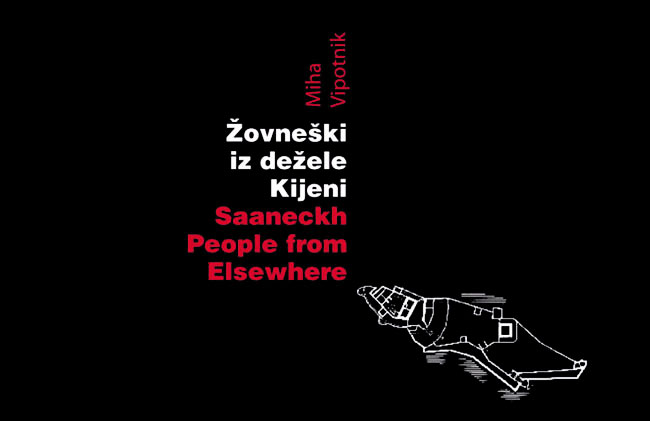
Miha Vipotnik: Žovneški iz dežele, ki je ni
An artist’s attempt to interpret the history of the leading noble family in Slovenia and to capture the spirit of the town of Celje Matija Plevnik
As of 9 November this year (2006), exactly 550 years have passed since the last of the Celje (Cilli) princes, Ulrik II, fell under the sword, victim of a plot. This act marked the collapse of the last great dynasty with its family seat on Slovenian soil, and at the same time the highest level of involvement in European politics. The history of the House of Celje has all the elements necessary for a high-quality screenplay: the rise, splendour, glory, incessant action, intrigues and plots, ill-fated love and a tragic ending. It there-fore comes as no surprise that the history of this famous family has attracted and continues to attract artists from various fields.
The origin of this noble family is not known. In the light of the first archived mention around 1130, we may conclude that they came from the ranks of the free nobles. It is suspected that they were a side branch of the high Bavarian nobility. Their allodial property (inherited estates free of obligations) was contiguous and close-knit, incorporating the territory of the central Savinja Valley. Fundamental importance was indeed ascribed by the Žovneks (the Counts of Celje) to the self-contained entirety of their possessions, something that was the exception rather than the rule among the estates of other nobles. A contract was made between the brothers permitting inheritance exclusively amongst each other. The Žovneks (sources also refer to them as “from Saunija” and as Lembergs) rapidly and persistently expanded their property and the power that went with it. They were patrons of Braslovce parish, and were also attorneys for the Benedictine monastery at Gornji Grad, and soon they acquired Lemberg, a feud of the Diocese of Gurk.
They further increased their power through marriages to important noble houses, with a major part being played by the double marriage ties with the Counts of Heunburg. When they died out, in accordance with the inheritance agreement the Žovneks acquired their possessions, crowned by Celje itself, which soon became the family’s administrative seat. At the beginning of the 14th century they became vassals of the Habsburgs, and in this way they merely enhanced their position, since they had a strong mercenary army that ensured for them a handsome and stable income. Herman I Celjski took as his wife Katarina, daughter of the Ban of Bosnia Stjepan II Kotromanić. Viljem Celjski on the other hand married Ana, daughter of the Polish King Kazimir the Great. These marriages further consolidated the political standing of the House of Celje. In 1372 Charles IV of Luxembourg, finally with the assent of the Habsburgs, elevated them (again) to state Counts of Celje.
After 1385 the reins of the family were taken over by Herman II Celjski, whose far-reaching and adept policies placed the Celje Counts alongside the ruling families of Europe. Decisively important in his half-century rule was the Battle of Nicopolis in 1396, where he saved the life of the Hungarian King Sigismund, the future Czech and German king and Holy Roman Emperor. He became the Emperor’s adviser, confidant, ambassador and member of the elite Order of the Dragon. As a reward, the Counts of Celje were able to markedly expand their territory in Slovenia and Slavonia and in Croatia. The mutual affection between the King and Herman was so deep that in 1406 Herman gave his daughter Barbara in marriage to Sigismund. Barbara Celjska has great historical importance. This highly educated woman, possessed of religious tolerance, was one of the first women scientists (astrology and alchemy), and as such represented the model of the Renaissance person. Since the territory in what is today Croatia was becoming important, in 1405 Herman II married off his son Friderik II to Elizabeta Frankopanska.
Their influence within the provinces of Austria proper increased further with the acquisition of the estate from the extinct dynasty of the Ortenburgs (1418), which included numerous possessions in the regions of Dolenjska, Gorenjska, Carinthia and Notranjska. Following the death of his first wife (supposedly dispatched by Friderik himself), without his father’s consent Friderik II married Veronika Deseniška, daughter of a petty and insignificant Zagorje noble. Herman II imprisoned his son and ordered his second wife to be drowned. However, owing to the accidental death of Herman’s three other sons, he was constrained to free Friderik and gradually groom him as his successor, even though the affront was never forgotten. All the family twists and turns notwithstanding, the House of Celje was not content with the title of mere counts, so they aimed even higher, to the title of state princes. The way was cleared for them to be named princes by the gesture of the Habsburg Ernest the Iron, who in 1423, on the initiative of Emperor Sigismund relinquished power over the House of Celje. The actual elevation to state princes took place in 1436, a year after the death of Herman II. As princes, Friderik II and Ulrik II held the right to mint money, to exploit mineral ores and the right to hold a court of the nobility. They became equals to the Habsburgs, concluding with them a mutual inheritance contract (1443). In 1430, with a grand and extravagant escort, Ulrik II embarked on a pilgrimage to Santiago de Compostela, one of the three main pilgrimage sites of Christianity. That this journey was also of great political significance is evident from the chronicles of the Castilian kings, which reported on this visit. In 1451 Friderik II granted Celje town rights.
The House of Celje strived with increasing vigour for power in individual provinces. In the Kingdom of Hungary they were state barons, and they were Croatian, Slavonian and Dalmatian bans (dukes), so in many places they ended up enmeshed in local conflicts. This interfering produced a wave of resistance among the “domestic” nobility, which led ultimately to the plot of the Hunyadis and consequently to the death of Ulrik II in 1456 in Belgrade. With the death of the Prince of Celje began the battle for the enormous inheritance. Contending for this were Katarina (Ulrik’s wife), the Gorica counts, Ladislaus Posthumous (King of Hungary) and the Habsburg Friedrich III. On the basis of the valid inheritance contract, it was Friedrich who took over the entire Celje possessions.
Alongside their political importance, the Celje Counts hold great importance in fine art. Paralleling the rise to the peak of their power, they enhanced their standing as patrons in the field of the arts. Indeed fine art is the final remnant testifying to the greatness of the Celje dynasty. Signs of their might were left on many sacral objects in heraldic form. As benefactors of the Carthusian order they provided considerable support to the monasteries of Žice and Jurklošter, and they also demonstrated their kindness to the Minorite monastery in Celje. A special place is occupied by the founding of the Carthusian monastery of Pleterje (building started in 1403), which was intended as the final resting place of Herman II. Especially around 1400, when there was a profusion of artistic monuments that enjoyed Celje patronage, their stylistic idiom was akin to that in the wider European area (Vienna, Prague, Straßengel), which points to close contacts with the grandees of Central Europe and consequently to their affinity for the artistic quality of the time. Exceptionally important is the Chapel of Our Lady of Sorrows in the Church of St. Daniel. All of its high-quality individual elements are harmonised into a wonderful artistic whole, comprising the private chapel of the House of Celje. Mention should also be made of the common institution of the high Styrian nobility, the pilgrimage church on Ptujska Gora with what is termed its Celje altar and the sculpted group of the Annunciation, as well as the Church of St. Rupert at Šentrupert in Dolenjska. Of the secular buildings, ambition, grandeur and haughtiness are indicated pre-eminently by the Prince’s Palace. With its pointed arch windows, which were a great rarity on secular buildings, cross-ribbed vaulted private chapel and the deliberately installed, fully sculptural female figure from antiquity in the medieval walls, a spirit of humanism and the Renaissance pervade the late Gothic tone of the space. These two phenomena were probably a consequence of the penitential pilgrimage Friderik II made to Rome, and on the way there he probably became acquainted with the new cultural orientations – the Renaissance and humanism. Excluding the Prince’s Palace, among Slovenian towns and cities these orientations only made it as far as Trieste. Another point worth noting is that with the demise of the Celje Counts and consequently of their engineering ambitions, in the Celje area right up to the 20th century not one single more prominent piece of architecture, either secular or sacral, has appeared that would generate more notice in Slovenia, let alone in Europe.
The above, merely superficial, historical outline must of necessity be taken as the central starting point for the interdisciplinary project by Miha Vipotnik. In his latest creation, four decisive factors should be highlighted: a) homage to historical art, b) the location of the project, c) the artist’s lack of regional encumbrance, and d) enhancement of the first three factors in terms of composing historical mosaics through the artist’s own creative experience and imagination.
Of key importance in this project is historical experience, from which emanates its narrative quality. The sense of history as such lies in preserving knowledge of the past. The very father of historiography, Herodotus of Halicarnassus, gave his first work the simple yet significant title of The History of Herodotus. Even the Latin word historia means ‘’story’’ in translation. The story itself is by its own definition an invented or truthful tale. History has often been explained through myths, legends and sagas, since in this way the reader/listener could more easily be drawn in, and the narrative was easier to remember. Artists are most interested in the accompanying, more succulent information that accompanies the skeleton of basic, factographic data, since that information can be much better interpreted in artistic media, plus the dialogue with the audience is more powerful. We may ask with justification whether history is what writes stories, or whether stories are what create history, and in this way we unwit-tingly approach Eco’s Baudolino.
Vipotnik is not encumbered by local views. As a “foreigner” he was able completely without pressure to create his own judgement of the town and its glorious history. With fragments of historical spaces and objects he has presented the former glory of the Celtic town of Keleia, the Ro-man Celeia, German Cilli, Slovenian Celje and the Celje of today, which is characterised by its youthful creative forces. In this way he establishes parallels between the past and present, and focused on the future, he makes sense of one of the fundamental missions of art – Art should show the public how the world should be.
Did the Žovneks believe in their own myths? Igor Španjol
In his latest book Postproduction1, Nicolas Bourriaud describes the latter-day artist as a kind of detective, who searches, processes and communicates a variety of information parallel to the official sources and the dominant media of data distribution. Since the 1990’s artists have tended more to reorganise than create new artistic works. Yet this is not a case of artists losing their creativity, but rather of their creation today being evident in a variety of processes.
Instead of the old concept of the blank page, when the artist established a world each time from nothing, today the world is full of cultural production, products and scientific discoveries. There is so much history behind us that artistic creation is pursued primarily through the reorganisation of what has already been done. This “post-production” is still artistic creation, it is just the method that has changed. It does not denote any denigration in the sense of repeating what has already been done, but a need for constant account to be taken of what has already been done.
On the one hand contemporary art is thus founded chiefly on quotations and historical references, and on the other the quotation used in the context of the artistic work no longer has any operative value in terms of pointing to the method by which the historical authority of some master stands behind the artist. Today artists do not quote others as authorities, rather they use artistic works to make completely different meanings that are more suited to the issues of our time. And it is precisely this difference between quotation and the use of artistic works that is the key change in art over the last 20 years.
This new situation has arisen primarily because of the enormous accumulation of information, which influences production. We are swamped with production and information, and we live in a so-called information age, which dictates different kinds of activities, including for artists. Many of them harness the power for artistic creation by collecting data and accumulating information. The artist today navigates through science, and seeks new knowledge by merging with science. If the modernism of the 20th century was founded on a projection into the future, here we are talking about the concept of a new discovery of the past, a region of boundless accumulation of data.
Today the artist can no longer work on global utopias, he can work only on a section of society, a specific community, on the local level or on some micro-utopias. Our imagery is no longer utopian, but is linked to everyday things that are much closer to us, and to issues that were not yet present in earlier art. Establishing some kind of historical media archives is not just one of the possibilities of what we can do with information; it is one of the fundamental forms of contemporary art. The information age does not signify specific forms, but a great many different forms. Information is everywhere and is the main value that drives the economy today, while the possession of information is the most highly prized asset on the global market. It has a very direct impact on how we see the world and how artists see art, but it is not tied to any specific concept of what art is, and art can be highly diverse in its manifestations. In his book Did the Greeks Believe in Their Myths?2 Paul Veyne deals with the issue of history and historiography, and especially with the point that “truths” and ideas have their own history, as do the actual criteria of truthful and untruthful. The author offers the reader his own personal vision, an image or programme of historical truth as a consideration of the forming of truth(s) in time, in line with the Nietzschean concept of “the truth that truth changes”.
In his introductory words to the Slovenian translation of Veyne’s book, Rastko Močnik states that in a situation where myths can be believed or not believed, or where we may believe in myths without believing myths, they fall within no ideological register, but serve as a “tool for connecting” from one register to another. In societies there are several “agendas of truth” at the same time and people are forced to choose between them and to make switches. “The general reason behind this need is what is in principle an ‘imperfection’, an incomplete ness of institutions whose regular functioning creates contradictory situations,”3 says Močnik.
The existence of different ideological registers is a condition for the survival of society. Since each situation can be described in different ways or in different “agendas of truth”, it can also be arranged and resolved in different ways. This ensures the reproduction or the changing and adaptation of the social structure. In short, what is important is that myths are told and that they function. You do not need to believe myths in order to believe in myths. This is frequently demonstrated by the use of mythological subjects in visual art and in rhetorical practice, and ultimately such a relationship is also indicated by the numerous scientific works that delve into the field of history and mythology.
In this interdisciplinary project Miha Vipotnik focuses on the intersection of these grasps, in the tradition of practices that understand the field of art as a relevant practice of historicisation. He delved into a specific geographical and historical experience, sifted thoroughly all the information that seemed to him necessary to set up the installation, studied everything that had already been done in this field and took the assembled information as the support for a new work which has also invited the visitor to be involved in the mental and physical shaping of the space, time and story or myth. On the foundation of the micro-situation under study he has creatively reconstructed the wider historical context and significance of the Counts of Celje, and has brought together various aspects of knowledge in order to formulate from this new experience his own way of thinking. Socially, politically and historically Vipotnik sees art as a toolbox, and uses situations from the past in order to portray new situations. For this reason his work cannot be used as an extended instrument of expertise included in the project or merely as an illustration of the historical events being dealt with. His work in fact goes far beyond this. Although in its entirety it involves more than just the sum of early forms, stories and media, individual elements at the same time function independently, be it the electro-acoustic music of Bor Turel, the photography of Vinko Skale, the cast relief of the Renaissance well or the use of a model of Celje Castle. As far as the elements of moving pictures are concerned, Vipotnik does not attempt at any price to invest his medium of video with some ambition of film production, but rather the specific film experience marks the entire dynamic scene of the installation.
Vipotnik has delved radically into the gallery space and has in fact structured it like time. In this mysterious and fascinating play the surfaces of the floor, ceiling and walls feature as echoes of the past, awakened by the pulsating light of the video projection. The visitor loses the floor beneath his feet, and this relativises his spatial as well as temporal experience, or rather his dominant historical position, where the nobles appear to us like some kind of Warhol-type media stars.
The multifaceted spatial composition is based on gaps, concealments, fissures and the conscious revealing of the constitutive elements of the installation. In this appears the need to deconstruct the myth, based on an understanding of historical narrative as an interwoven, complex sum of intimate stories, coincidences, gaps, abysses, side alleys and intervening undefined spaces. Vipotnik’s new reading of historical events is obsessive and poetic, but not naïve and romantic. He pursues history as if he were speaking about the present, speculatively and with a bias, with living players and intrigues. His detective’s grasp is therefore shown in this part on at least two levels – both narrative and methodological.
The substantive new reading of history is appropriate to the formal digital construction of the castles, and to the reconstruction and layering of the actual architectural space. The foundations of the exhibition building are material accents, like some kind of orientation points within an opaque span of time. The use of new media technologies, with their basis in the principles of painting, open up the space to links between the figurative and abstract, local and global, specific and symbolic, technological and organic, and terrestrial and cosmic.
Instead of talking about the exhibition and exhibiting, in this case it would be more precise to talk about some kind of contradictory composition, where chaos is a key element in the organisation of the space, while the holographic and psychedelic atmosphere has a calming and pleasant effect. This kind of installation has enabled a unique withdrawal from the world that surrounds us and in which the media industry, with its production of the virtual image of this world, approaches myth in functional terms. The exhibition therefore acts as an alternative to the dominant interpretive principle of the world, where through modern mass-media approaches the artist confirms Barthes’s idea that myth is something socially reflected.
1 Nicolas Bourriaud, Postproduction, Lukas & Sternberg, New York, 2002.
2 Paul Veyne, Les Grecs ont-ils cru à leurs mythes? Essai sur l’imagination constituante (Editions du Seuil, 1983).
3 Rastko Močnik, Mit v teoriji ideologije (Myth in the theory of ideology), in: ibid., p. 221.
Synchronous fragmentation as a strategy of viewing history Petra Kapš
At a time when under the pressures of national extinction, Slovenia’s cultural, social and political past is continually topical, dealing with the phenomenon of the Counts of Celje is especially interesting. The awareness of a need for continuous rethinking of individual constructional elements of history (histories), the revitalisation of individual events and persons, given the prevailing historisational paradigms based on a linearly selective approach, is unavoidable. The Counts are an episode in Slovenian history that offers a sense of nobility and not simply the past; they are a desire that somewhere beneath the surface weaves the present and the future.
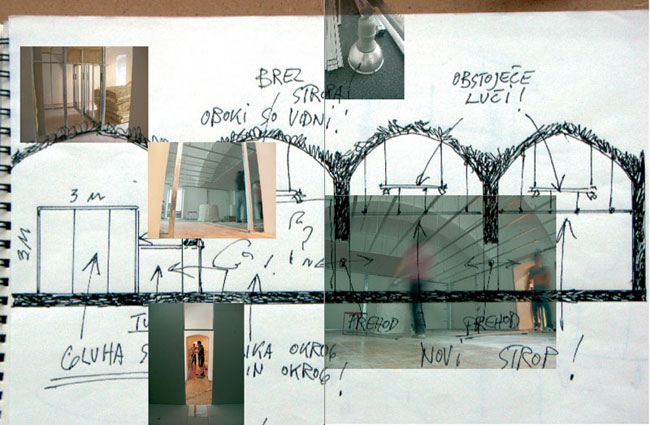
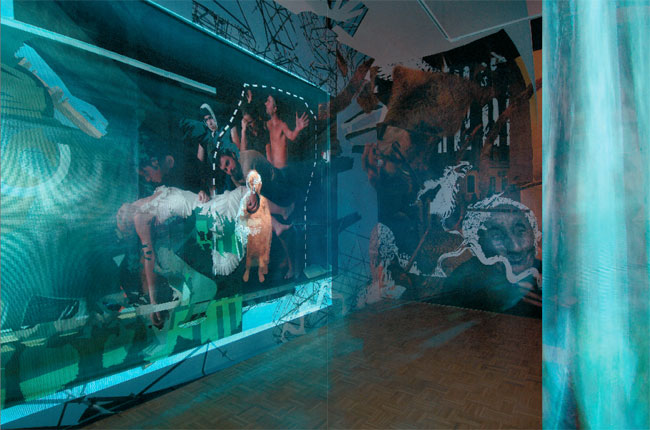
The Counts of Celje reveal themselves as reality, myth, phantasm, aspiration and, over and over again, as the subject of artistic treatment. The installation by Miha Vipotnik entitled Žovneški iz dežele, ki je ni (Žovneks from a land that is no more) is a juxtaposition of several levels of time and space. The conglomerate of scene de-sign elements, video projections, sounds, animation, computer graphics, photographs and electronic media is placed in a radically redesigned gallery space and environment of sensors. The transformation of the physical space, effected through architectural and colour interventions, is included in the playing with the human apparatus of perception; it is the basis for sharpening sensory experiences. The ‘black’ of the walls and the reduction of light create a ‘darkened’ atmosphere, which by evoking constrained, at certain moments even claustrophobic feelings, influence one’s experience of the work. The impression of the space is analogous to collective, such as theatres and cinemas, underground (tunnels, subways in urban environments, cellars) and above ground (even cosmic) spaces and to the subconscious, in which either in reality or metaphorically we place the nexus of key moments, sections and shifts in the progress of an event. And the story is set out in fragments, opening up potentially in the intervening spaces.
The link of significance and motif into the broadly interpretative installation is established on the level of the viewer’s associative connection between the images of the relics of reality from the life of the Celje Counts, in a field of media image-creation and art history references.
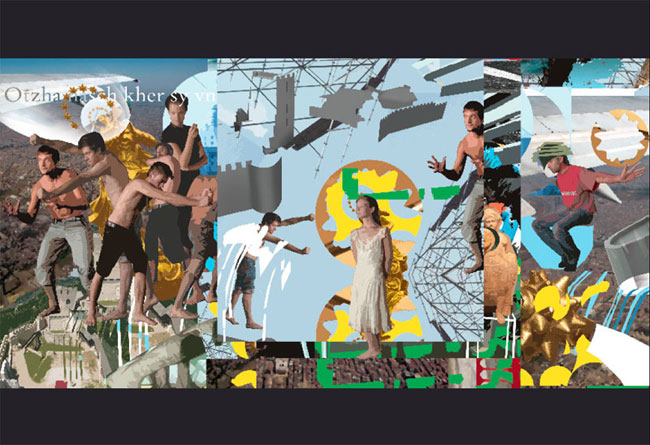
The installation extends into four exhibition spaces. The ‘temporary’ gallery front is furnished with a gigantic panel with a digital composition, whose narrative thread comprises a mass of signs, images, faces, bodies and gestures, intimations and memories. Establishing the reference framework and reading the individual elements derives from a thematisation of the syntagma in the title. Recognition and (dis)agreement seem at first glance random and non-binding, but a closer look reveals in the images the enigmatic identity of the signifiers – the constitutive elements of the story of the Celje Counts (and of Celje): from the Old and Lower Castles, Istanbul, the symbolisation of power on the one hand through the movements and poses of male bodies and on the other hand through the abstraction of a club, the image of a woman, the statue of a Roman soldier and the quotation from the Lord’s Prayer, as well as the significant word play over the entrance to the gallery – tv. The repetition of these (and a mass of other) elements is the basis of the installation.
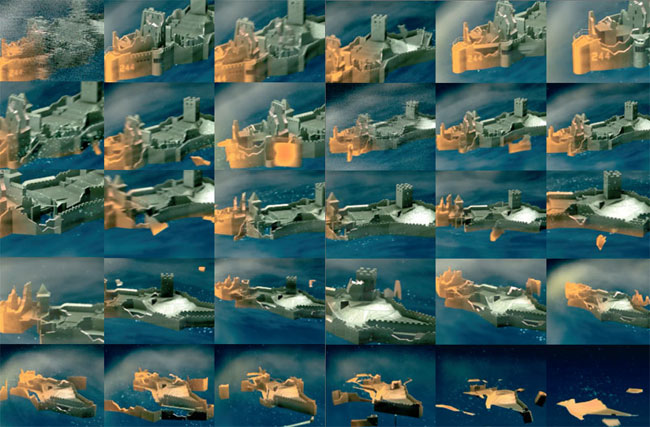
A representation of the ceiling of the Chapel of St. Mary from the Church of St. Daniel, reproduced as a flat image, is revealed on the floor of the first room. A fascination over the spatial illusion of the Gothic ceiling is pre-vented. The reverse of the usual order of things, the play with the viewer’s perception, the artist’s intervention in reproducing the ceiling and the exaggerated light, which does not illuminate but obscures (the image), convey an ironic attitude, although not to the past itself, but to the untouchability of the preserved artefacts of history, the selected basis of our social and cultural present. We may trace the thematisation of these ideas in the room with the well-tree (this is a cast of the relief of a Renaissance well). Despite the distinct material presence of the structure, the space is dominated by the sonic environment (the creator of the sound is composer Bor Turel), located in the interior of the well. It seems that from the ‘depths of the past’ emerges a chaotic fusion of unclear sounds, words and phrases that percolate through our consciousness and cling to recognised particles. The artist guides the viewer to the act of listening and the production of internal images, which stem from interference with what has already been perceived. The amplification of audio stimuli and the isolation from external images provoke an inner experience, and activate the individual’s thought-memory associative process. And if here we can also talk of the possibility of a meditative journey, in the third room the viewer enters into an image, and his view is entirely filled by visual means. Projected onto a frame suspended in the middle of the space is the ‘preserver of the picture’ – the static figure of a Roman soldier, as the focal point of the viewer’s gaze or his point of entry into the events, is inserted in the photomontage that contains a paraphrasing of Caravaggio’s painting Laying in the Tomb, but here in place of Christ is a young women, perhaps Veronika? ... The picture is repeated as a digital print on the wall. The projection of the animated picture with minimal shifts onto the wall image, and the static Roman soldier, shift the issue to the painter’s field and to the principle of postmodernist heterogeneity, which requires the termination of other possible variants. At a sensor impulse the ‘preserver’ is terminated, and is continually followed by a video or animation, which in flashing rhythm lays down image upon image. We can make out the world of sport (the attraction of body and movement is obvious), capital and advertising strategies (in the video, in which the viewer ponders the moves and the mimicry of the actor’s face, the artist recycles the advert for Banka Celje), comodification and consumerism, sexuality, art history references, the universe and space travel. The inspiration for this last feature is revealed in the phenomenon of the rapid rise, flourishing and self-destruction of the Celje Counts – there is an interplay of the huge lights in the first room as a representation of ‘rocket lights’, shots of spacecraft lifting off, and, as the key section, the video featuring the motif of a model of the Old Castle as a space ‘cruiser’, a comet, which in hurtling through the cosmic sphere gradually and entirely disintegrates. For a moment the screen stays black. The symbols used are repeated through history, and owing to the created (constructed) universality and legibility we may apply them to local, individual environments, where owing to the particular characteristics of the individual and society they acquire a specific connotation. The wall picture, which covers the entire space, is like a backdrop of the narrative of civilisation, and sequences of the ‘facade’ picture appear, with new ones added, also (in)directly connected with Celje. The actors present archetypal scenes: the previously mentioned reconstruction of Caravaggio’s Laying in the Tomb, Supper at Emmaus, a suggestive still life and film clips whose original context is imprinted in the material of our memory. The artist’s principle of selectivity exists of course, as does the order of images (what is random is our following of individual entities), yet it seems that this order is not vital for our experiencing or reflection, and what is important is the uninterrupted linking of the visual. It therefore draws the viewer (or not depending on the viewer himself) into his own thought process. The interpretation of images is open, and following the key of meaning is contingent. The fusion of images and sounds ... reflects the grasp of time only as now, it portrays a web that (co-)establishes the past, the present and future in now, in the logic of the web world; historical memory is not essential; there is no hierarchy, but contemporaneity.
Through the transitions between individual spaces, which become narrower, darker and longer, adding to the dramatic effect, the artist succeeds in enhancing the feeling of instability, which the sterilised images of today’s media world are no longer capable of providing. We enter the final room, a space of silence, through a tunnel with a floor of brick and boards, for which we may only surmise that they are from one of the scenes of the Celje Counts. Something is projected onto the floor, and it looks like a well. The narrowness and tension let up, and from the mass of video and animation clips emerges an allusion to the driving force of existence: love, personified as a girl swimming upward to the surface – Veronika? – and money. The movement of the coin reminds us of the gesture of tossing a coin with the eternal question: heads or tails – here we have the head of Primo` Trubar with the suggestive inscription ‘stati in obstati’ (to stand/cost and exist) on a Slovenian euro coin. The interweaving projections of web animations, videos and text fragments, which preserve the dictate of the image and the ruthlessly rapid rhythm of changes, are broken by moments of water scenes; the feeling of the aquatic atmosphere with its radiating rays of light and the silence of the space work towards an equilibrium. The story remains open.
Vipotnik stages his own fascination with this historical topic, which in his point of view, however, is not based on yet another recontextualisation and reconstruction of historical facts. The constitution of the situation is a collection of fragments, images and sounds, interwoven synchronously as a digital print without the illusionist tricks of diachronism. The inclusion of narrative elements does not follow the hierarchical principle of importance, recognisability and value, but progresses as a web. The installation is not a unified, compact whole, it is a compound. At first glance it seems as if we are entering a palimpsest creation of the postmodern world, but the images, texts and sounds are open, there are no (longer any) secrets, there is no magic of hidden, ancient writings, everything is on the surface. The challenging and complex installation for the spectacular image somehow leaves the viewer unsated, and the visuality loses its power to address. The acquisition of images is simple today, and the use of the thoughts and writings of others and views into their emotional state are desirable ... but it is as if there are no relationships between them. The words, images and voices pursue Lyotard’s ethic of total heterogeneity and contingency, in which there is no consensus, since a consensus assumes a colonialist conquest and thereby the subjugation of one of the two (or mass of) discourses, myths and histories. Yet these require autonomy, and a limitless number of histories is essential (but any selection appears a priori to be an act of aggression over those not present). And if we extend this thought, then the variation on the subject of the Celje Counts is an opening up of suppressed possibilities, attention to what has been forgotten and excluded, and concern for what is absent.
A poetic reply to the strategy, procedures and reflections in Vipotnik’s Žovneki Marijan Pušavec
Myth is the honey for spreading history on the bread of everyday temporality.
• Anonymous
Disciplined science presents history and the past as a belt, a straight line, that explains the flow, causes and consequences of events in the past.
Yet the more undisciplined people dealing with the past there are, the more they mythologise it. Their delving and individuality no longer serve the purpose of objectively presenting cause-and-effect events. In summary they do not seek the properties and common features of some phenomena or social machineries in retrospect.
They do their detection in a field of ideas and images that are not tied to a political geography, but rather to a mental geography of time-space.
The mental historical geographer-alchemist and digital painter Miha works his approaches of mise-en-scene to transform the once cause-and-effect reality into the ambiental, poetic landscape that JENI was.
Herein lies the key difference between the disciplined historian and undisciplined artist.
In this case there is an undisciplined artist hand in hand with disciplined historians. But only up to the gates of the temple or shrine.
Heut die Grafen von Cilli und Niemandwieder.
Their vibrations and reflexes in time and space, a stone and imaginary architecture. And power and self-confidence.
The disciplined conduct research in the context of politics, society, economics ...
In the mental categories of western man.
The undisciplined conduct their research in the context of ideas and images.They leap across space and time.
They are always creating something new, at times utopian, at times metaphorical.
The difficulty is in the tuning. And how far to go beyond the conditioned pattern of presentation.
The best thing is to enter the aggregate relaxed. In expectation, like in the cinema or theatre.
The aggregate presents outwardly a presence in a transparent veil, which is the breeze between physical space and history.
Or in the simulation of a medieval fresco. In the manner of an advertising hoarding.
Physical spaces are the network that we activate when we enter into them.
Sounds, aural polyphony as a time machine. A translator between other feelings.
An emanation of the spirit of the times. Sonic earth.
Panta rhei. Everything jumps.
Time-space, things and the people in it.
A mighty appearance throws a long shadow. And it lasts a long time.
Power, money, territory. Women like in Shakespeare, fatal, pernicious.
Deadly. All mothers. All sows?
And a mass of children. For the whole village. For the whole of Teharje.
Our Father!
Build a house by the river. A house on a house palace.
A country on a country state. A state on a state empire.
The archipelago of Venice-Aquileia-Salzburg-Vienna. Croatia-Bosnia-Serbia-Ottoman Empire.
And here a large library of learned books.
The masters did not just wage war and fuck, they read Latin and German books.
They exploited the Slovenian serfs.
Like some blithe self-evidence. A real chivalric tale. With elegance and the poetry of the troubadour. With a court that provided two queens.
In the series there is an interesting letter B.Even now it is the centre of the map.
And in the centre of the other map are the two women.
How the map of passion and the map of time-space overlap!
The land that JENI was.
A thousand years of yearning to be one’s own master. And then seeking a new master.
Where is the heart of this palimpsest scenery? It beats like seeing.
In the floors of thousand-year cellars, through which the Roman peoples marched towards the east or towards the west.
And beneath the road the audible inflow of the river. It is still flowing down.
Vibrant Atmospherics and the Writing of History Lisa Parks
When you approach the Hodnik gallery in the old town of Celje, Slovenia, you encounter an old castle in ruins, fragile, crumbling and surrounded with orange tape signaling to passersby to stay clear. At the entrance to the gallery next to the castle sits a massive, billboard-sized mural that is reminiscent of socialist propaganda posters, featuring several figures standing in stalwart poses looking as if they are hard at work building urban infrastructure. These tricky figures, however, are actually young Celje artists who have been cast by Slovene artist Miha Vipotnik as key players in his mischievous re-enactment of the town’s medieval past. The exhibition, Žovneški iz dežele, ki Jeni (or People from Elsewhere), irreverently mixes the iconography and memory of Slovenia’s (and Yugoslavia’s) modern socialist history with ac-counts of the region that date back further in time to the middle ages when the notorious counts of Celje reigned over the region and wielded power throughout Europe. The young artists on the mural symbolically stand in as the modern day counts of Celje, but rather than control wealth and bloodlines, they bring new images and ideas into the world from this vital part of an expanding European Union.
Perched at the gallery entrance, these heroic figures set the stage for the sprawl of temporal and spatial experiments that Vipotnik composes inside the gallery. There, we witness a dense layering of images, sounds, texts that mish-mash and flip-flop Celje’s history in multiple directions, scattering its traces across the walls, floors and acoustic space. For instance, images of a spinning Euro turn into a satellite dish placed underwater in the Adriatic Sea. Pieces of communication infrastructure are intertwined with the hair of a Mongolian camel. A close up of a ring on a woman’s finger twinkles near a photo of the Istanbul skyline. A silver tree made out of chicken wire sits upside down inside a well. The ceiling of a Celje church becomes a carpet that we walk upon. The complex-ity of this topsy-turvy visual field is accentuated by an equally challenging and imaginative sound mix designed by well-known Slovene composer, Bor Turel, which interweaves the sounds of wind, screams, medieval music, insects, water, and whispers among many other things.
To develop this installation, Vipotnik acted much like a historian would. He moved to Celje where he conducted research in archives and libraries, interviewed local civic authorities and archaeologists, visited historic sites, and talked to locals with intimate knowledge of the city’s past. After months of gathering information about Celje’s history, Vipotnik invented his own provocative language in which to articulate this region’s unique past. Using modern digital media he presents us with an array of audiovisual composites--layers of images and sounds--some of which contain literal references to Celje, Slovenia and Europe and others are more metaphoric and allegorical. Vipotnik challenges us to imagine Celje’s past as a vibrant atmospheric rather than a neatly unfolding chronology that one might find in a history book. For him the writing of history spills out and leaks in different directions. It has both micro and macro structures. It is personal and political, involves love and war, noise and silence.
The dizzying sensation of Vipotnik’s historical recounting is perhaps most intense when the visitor enters the central room of the exhibition. Walking through the darkness and into this vivid and moody chamber, one has the feeling of entering the historian’s unconscious or heart (which are effaced in most scholarly accounts of the past). In this room, elements of past and present collide in surprising and unpredictable ways. A thin translucent screen suspends from the ceiling and transects the space, flickering with a mélange of images and written text that scurry across the screen’s surface. What first appears as a Carravagio painting “Taking of Christ” is suddenly animated and the Celje artists we encountered on the billboard outside re-appear in a dreamy pastiche of motion pictures and classical painting. Moments later an intricate trail of words and text appears much faster than the eye can keep up. Historic documents are digitized, dissected, rearranged and read back to us as a field of unintelligibility. Text runs in multiple directions, is magnified with a zoom and then blurs only to suddenly disappear. The elusive presentation of words and text functions as an homage to the weary eyes of the historian. And, at the same time, it reminds us there are modes of historic engagement that exceed the word and that involve an emporium of the senses, which, as Guiliana Bruno reveals in her book The Atlas of Emotion (Verso, 2002), can be energized by the interplays of images, sounds and architecture.
Rather than take the approach of realism—the compulsory and beloved discourse of classical historiography—Vipotnik dares to present history in the form of an enigma, challenging his visitors to draw inferences, to assemble puzzles and, when he/she leaves, to take away not full comprehension of the historic past, but rather a glimmer, a glimpse, a sense both of what it might have been like and what it never was.
The effect of Vipotnik’s vibrant atmospherics is to generate a playful revelry in and revivification of the historic past rather than a rational interpretation of it. The idiosyncratic elements of the exhibition are nicely balanced with more serious concerns that relate not only to the writing of history, but the political provocations of art. By focusing our attention upon a moment in Slovenia’s history when political authorities exercised diplomacy in the interest of difference by fostering religious, linguistic, and ethnic integration, Vipotnik challenges the visitor to contemplate the current composition, disposition, and priorities of the new state of Slovenia. When the counts of Celje ruled, several languages (German, Latin, Slovenian) were spoken throughout the kingdom, different religions were practiced, and families of different ethnic backgrounds intermixed. Today Slovenia is by comparison quite homogenous. Will Slovenia’s new political leaders appreciate and draw upon the region’s rich history of difference for inspiration? Or will they position their new state as a space of nationalistic unification, or an economic back-yard or border patrol zone for Western Europe and the US? Vipotnik’s work engages indirectly with such questions by combining iconography of the past and present. By placing images of a shiny new Euro in the middle of Celje’s stari grad, he cautions us not to plunge into the future without reflecting upon the region’s past.
Art is most powerful when it finds subtle ways of commenting upon the world without being prescriptive or dog-matic. By catapulting us into a wormhole toward medieval Celje, the Žovneški iz dežele, Kijeni exhibition man-ages to pose questions about Slovenia’s past that reverberate with its current and future position in Europe. The writing of history is moving fast beyond the confines of the scholarly academy, beyond logo-centric understanding, beyond the vaults of the archive, and is taking on exciting new forms in the hearts, minds and galleries of artists like Miha Vipotnik who move between older times and the frontiers of new Europe.
